

GLP-1 Receptor Agonists and Medical Weight Loss: What the Research Shows
Updated: Oct 21
By HGHThailand Team
In the United States, GLP-1 receptor agonists are prescription medicines that copy a gut hormone called glucagon-like peptide-1, which helps regulate appetite and blood sugar. Semaglutide, tirzepatide and liraglutide belong to this group. Randomised trials report average weight and glycaemic changes, and results differ between people; the medicines also carry reported adverse effects.
Key points
GLP-1 receptor agonists mimic the incretin hormone GLP-1; tirzepatide also activates the GIP receptor.
Randomised trials report average weight reductions when the medicines are used alongside diet and activity support.
The most commonly reported adverse effects in those trials were gastrointestinal.
In the United States these products are prescription-only medicines, and the approved indications differ by brand.
Trial results are averages from defined groups, not guarantees for an individual, and the medicines are not suitable for everyone.
What Are GLP-1 Receptor Agonists?
GLP-1 receptor agonists are a class of medicines that bind to and activate the same receptor as the natural hormone glucagon-like peptide-1 (GLP-1). Because they act like the body's own hormone, they are described as incretin-based therapies (Nauck and D'Alessio, 2022). The class includes semaglutide, liraglutide and, as a related dual agonist, tirzepatide.
The word "agonist" refers to a substance that switches a receptor on. GLP-1 is released from the gut after eating and is part of the incretin system, a set of signals that help the body manage a meal. These medicines are designed to produce a longer-lasting version of that signal (Moiz et al., 2025).
Tirzepatide is slightly different. It is a dual glucose-dependent insulinotropic polypeptide (GIP) and GLP-1 receptor co-agonist, meaning it activates two receptors rather than one. GIP is another incretin hormone, and both receptors are found in the pancreas and in brain regions that help regulate food intake (Nauck and D'Alessio, 2022).
How the Incretin System Works
The incretin system links the gut to the rest of metabolism. When food is eaten, cells in the intestine release incretin hormones, mainly GLP-1 and GIP, which travel in the blood and send signals that prepare the body to handle the incoming nutrients (Moiz et al., 2025).
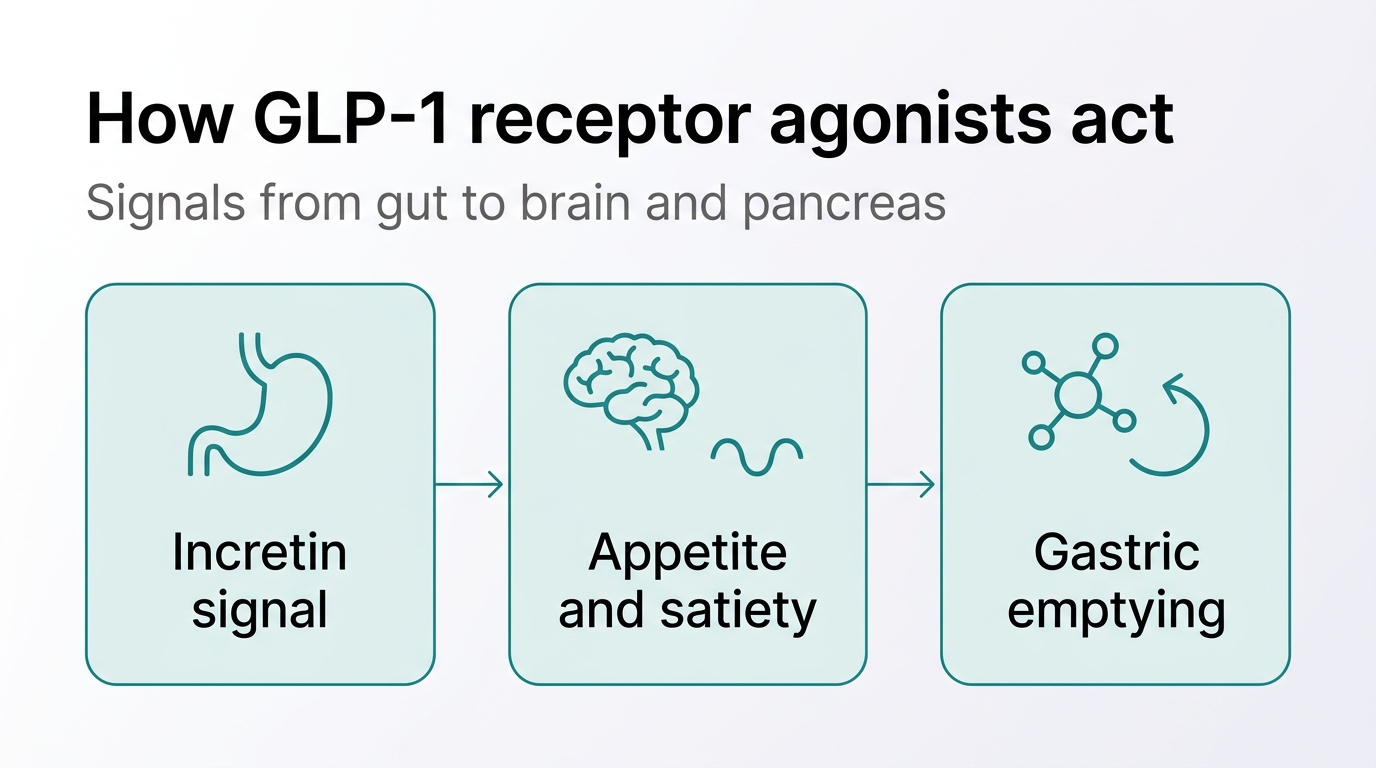
Reviewing the research, Moiz et al. (2025) describe two broad groups of effects:
Central effects (brain). GLP-1 receptor agonists act on brain regions that control appetite, influencing the release of neurotransmitters and peptides that regulate hunger and energy use.
Peripheral effects (gut and pancreas). They enhance insulin secretion when glucose is high, reduce glucagon release, and slow the emptying of the stomach. Slower gastric emptying helps a person feel full for longer.
Together these effects are thought to explain the appetite suppression and metabolic changes reported with this class. Nauck and D'Alessio (2022) note that GIP and GLP-1 receptors are also expressed in brain areas that regulate food intake, which is why dual agonists such as tirzepatide are studied for effects on body weight in that review of type 2 diabetes treatment.
This is a simplified account. The full picture involves many organs and feedback loops, and researchers continue to study exactly how much each pathway contributes to the outcomes seen in clinical trials.
What Randomised Trials Report for Weight
Several large randomised trials have tested GLP-1 receptor agonists for weight management in adults, usually alongside a reduced-calorie diet and increased physical activity. The table below reports mean changes as published, and these are group averages rather than what any one person can expect.
Trial (source) | Medicine and target | Population | Mean weight change (as reported) |
STEP 1 (Wilding et al., 2021) | semaglutide, GLP-1 receptor agonist | 1,961 adults with overweight or obesity, without diabetes, over 68 weeks | about 14.9 percent reduction versus 2.4 percent with placebo |
SURMOUNT-1 (Jastreboff et al., 2022) | tirzepatide, GIP and GLP-1 co-agonist | 2,539 adults with obesity, without diabetes, over 72 weeks | about 15.0, 19.5 and 20.9 percent across the three tirzepatide groups versus 3.1 percent with placebo |
SCALE (Pi-Sunyer et al., 2015) | liraglutide, GLP-1 receptor agonist | 3,731 adults with overweight or obesity, without diabetes, over 56 weeks | about 8 percent versus 2.6 percent with placebo (roughly 8.4 kg versus 2.8 kg) |
In STEP 1, more participants on semaglutide than on placebo reached weight reductions of at least 5, 10 and 15 percent, and the trial also reported improvements in cardiometabolic risk factors and in self-reported physical functioning (Wilding et al., 2021). In SURMOUNT-1, the proportion of participants who reduced their body weight by at least 20 percent was about 50 percent and 57 percent in the two higher of the three tirzepatide groups, compared with about 3 percent on placebo (Jastreboff et al., 2022). In SCALE, about 63 percent of the liraglutide group lost at least 5 percent of body weight, compared with about 27 percent on placebo (Pi-Sunyer et al., 2015).
These results, and the approved indications described further below, apply to the specific authorised products that were studied and licensed. They do not necessarily transfer to other preparations of the same active substances.
The trials were funded by the manufacturers of the medicines tested: Novo Nordisk for STEP 1, SCALE and SELECT, and Eli Lilly for SURMOUNT-1 (Wilding et al., 2021; Jastreboff et al., 2022; Pi-Sunyer et al., 2015; Lincoff et al., 2023), which is worth noting when reading the findings.
Glycaemic and Cardiovascular Outcomes
Because GLP-1 and GIP are involved in insulin and glucagon signalling, these medicines were first developed for type 2 diabetes (Nauck and D'Alessio, 2022). In a review of the SURPASS programme, Nauck and D'Alessio (2022) report that tirzepatide reduced HbA1c, a marker of average blood glucose, by roughly 1.24 to 2.58 percentage points and body weight by roughly 5.4 to 11.7 kg in adults with type 2 diabetes. These figures come from studies in people with diabetes, so they should not be read as typical results for other groups.
Cardiovascular outcomes have also been tested. In the SELECT trial, Lincoff et al. (2023) studied 17,604 adults aged 45 or older who had existing cardiovascular disease and overweight or obesity but no diabetes. Over a mean follow-up of about 39.8 months, the primary cardiovascular endpoint occurred in 6.5 percent of the semaglutide group compared with 8.0 percent of the placebo group (hazard ratio 0.80; 95 percent confidence interval 0.72 to 0.90). This was a trial of one medicine in a specific high-risk group, so the finding applies to that population rather than to everyone.
Reported Adverse Effects
In the United States these are prescription-only medicines, and they are not risk-free. The trials report a consistent pattern of gastrointestinal side effects.
In STEP 1, nausea and diarrhoea were the most common adverse events with semaglutide and were typically transient and mild to moderate; more participants stopped treatment because of gastrointestinal events than on placebo (4.5 percent versus 0.8 percent) (Wilding et al., 2021).
In SURMOUNT-1, the most common adverse events with tirzepatide were gastrointestinal and mostly mild to moderate; treatment discontinuation due to adverse events ranged from about 4.3 to 7.1 percent across groups versus 2.6 percent on placebo (Jastreboff et al., 2022).
In SCALE, the most frequently reported adverse events with liraglutide were mild or moderate nausea and diarrhoea; serious events occurred in 6.2 percent of the liraglutide group and 5.0 percent of the placebo group (Pi-Sunyer et al., 2015).
In SELECT, adverse events leading to permanent discontinuation occurred in 16.6 percent of the semaglutide group and 8.2 percent of the placebo group (Lincoff et al., 2023).
The US product labels also carry a boxed warning: in rodents, semaglutide, tirzepatide and liraglutide caused thyroid C-cell tumours, and it is not known whether this applies to humans. The labels state that these products are contraindicated in people with a personal or family history of medullary thyroid carcinoma or a condition called Multiple Endocrine Neoplasia syndrome type 2 (US Food and Drug Administration labels, via DailyMed).
A review of semaglutide safety (Smits and Van Raalte, 2021) examines the safety data from the medicine's phase 3 and cardiovascular outcome trials. The list of adverse effects above is not exhaustive; the full prescribing information should be consulted for the complete set of warnings (US Food and Drug Administration labels, via DailyMed). Anyone considering treatment should discuss the benefits and risks with a qualified healthcare professional.
How These Medicines Are Regulated
The exact rules depend on the country. In the United States, products containing these substances are prescription medicines. The approved labels state the following:
Semaglutide, brand name Wegovy (injection). Labelled "Rx only" and described as a prescription medicine used with a reduced-calorie diet and increased physical activity. Its indications include reducing the risk of major cardiovascular events in adults with established cardiovascular disease and obesity or overweight, and reducing excess body weight and maintaining weight reduction long term in adults and in children aged 12 and older with obesity (US Food and Drug Administration label, via DailyMed).
Tirzepatide, brand name Mounjaro. A prescription medicine indicated, alongside a reduced-calorie diet and increased physical activity, to reduce excess body weight in adults with obesity or overweight with a weight-related condition, and to treat moderate to severe obstructive sleep apnoea in adults with obesity (US Food and Drug Administration label, via DailyMed).
Liraglutide, brand name Saxenda. Indicated, with a reduced-calorie diet and increased physical activity, for weight reduction in adults and children aged 12 and older with a body weight above 60 kg and obesity, or adults with overweight plus a weight-related condition (US Food and Drug Administration label, via DailyMed).
This article gives the position in the United States only, because that is the label set read for this page. Approval status, approved indications and the legal rules for sale differ from one jurisdiction to another. Outside the United States, national regulators set their own terms, and readers should check the regulator in their own country rather than assume that the US position applies.
How to Read This Evidence
A few caveats help keep these findings in perspective.
The figures above are means from groups. Individual responses vary widely, and some participants had little or no weight change.
The trials used the medicines together with diet and activity support, so the reported results reflect that package of care rather than the medicine alone.
STEP 1 and SURMOUNT-1 excluded people with diabetes, while the SURPASS figures come from people with diabetes, so the studies are not directly comparable.
The trials were funded by the manufacturers, and most ran for under two years, so long-term outcomes beyond those periods are less certain.
This information is for education only. It does not tell anyone what to take and is not a substitute for advice from a qualified healthcare professional.
Frequently Asked Questions
Are GLP-1 receptor agonists prescription medicines?
In the United States, yes. The approved labels for products containing semaglutide, tirzepatide and liraglutide state that they are prescription medicines ("Rx only"), each with specific approved indications. Rules vary by country, so check your own national regulator.
What is the difference between GLP-1 and dual GIP and GLP-1 receptor agonists?
GLP-1 receptor agonists such as semaglutide and liraglutide activate the GLP-1 receptor. Tirzepatide is a dual agonist that also activates the GIP receptor, and both receptors are involved in insulin release and appetite regulation (Nauck and D'Alessio, 2022).
What do the trials actually show?
The randomised trials in the table report average weight reductions in defined groups, measured over set periods and alongside lifestyle support. They are evidence about those groups, not a promise of a particular result for an individual.
What adverse effects are reported?
Gastrointestinal effects such as nausea and diarrhoea are the most commonly reported, and the labels carry a boxed warning about thyroid C-cell tumours seen in rodents. Reported rates of stopping treatment because of adverse events differ between trials and groups. The list is not exhaustive; see the full label for all warnings.
Do these medicines replace diet and exercise?
No. The trials studied the medicines together with a reduced-calorie diet and increased physical activity, and the labels describe them as additions to that care (US Food and Drug Administration labels, via DailyMed).
Disclaimer
This article is informational only and is not medical advice. It does not recommend any medicine or treatment. Always consult a qualified healthcare professional about your own situation.
Sources
Wilding JPH, Batterham RL, Calanna S, et al. Once-Weekly Semaglutide in Adults with Overweight or Obesity (STEP 1). New England Journal of Medicine. 2021;384(11):989-1002. PMID: 33567185. DOI: 10.1056/NEJMoa2032183. https://pubmed.ncbi.nlm.nih.gov/33567185
Jastreboff AM, Aronne LJ, Ahmad NN, et al. Tirzepatide Once Weekly for the Treatment of Obesity (SURMOUNT-1). New England Journal of Medicine. 2022;387(3):205-216. PMID: 35658024. DOI: 10.1056/NEJMoa2206038. https://pubmed.ncbi.nlm.nih.gov/35658024
Pi-Sunyer X, Astrup A, Fujioka K, et al. A Randomized, Controlled Trial of 3.0 mg of Liraglutide in Weight Management (SCALE). New England Journal of Medicine. 2015;373(1):11-22. PMID: 26132939. DOI: 10.1056/NEJMoa1411892. https://pubmed.ncbi.nlm.nih.gov/26132939
Lincoff AM, Brown-Frandsen K, Colhoun HM, et al. Semaglutide and Cardiovascular Outcomes in Obesity without Diabetes (SELECT). New England Journal of Medicine. 2023;389(24):2221-2232. PMID: 37952131. DOI: 10.1056/NEJMoa2307563. https://pubmed.ncbi.nlm.nih.gov/37952131
Moiz A, Filion KB, Tsoukas MA, Yu OH, Peters TM, Eisenberg MJ. Mechanisms of GLP-1 Receptor Agonist-Induced Weight Loss: A Review of Central and Peripheral Pathways in Appetite and Energy Regulation. American Journal of Medicine. 2025;138(6):934-940. PMID: 39892489. DOI: 10.1016/j.amjmed.2025.01.021. https://pubmed.ncbi.nlm.nih.gov/39892489
Nauck MA, D'Alessio DA. Tirzepatide, a dual GIP/GLP-1 receptor co-agonist for the treatment of type 2 diabetes. Cardiovascular Diabetology. 2022;21(1):169. PMID: 36050763. DOI: 10.1186/s12933-022-01604-7. https://pubmed.ncbi.nlm.nih.gov/36050763
Smits MM, Van Raalte DH. Safety of Semaglutide. Frontiers in Endocrinology. 2021;12:645563. PMID: 34305810. DOI: 10.3389/fendo.2021.645563. https://pubmed.ncbi.nlm.nih.gov/34305810
US Food and Drug Administration. WEGOVY (semaglutide) injection, prescribing information. DailyMed, National Library of Medicine. SetID: ee06186f-2aa3-4990-a760-757579d8f77b. https://dailymed.nlm.nih.gov/dailymed/drugInfo.cfm?setid=ee06186f-2aa3-4990-a760-757579d8f77b
US Food and Drug Administration. ZEPBOUND (tirzepatide) injection, prescribing information. DailyMed, National Library of Medicine. SetID: 487cd7e7-434c-4925-99fa-aa80b1cc776b. https://dailymed.nlm.nih.gov/dailymed/drugInfo.cfm?setid=487cd7e7-434c-4925-99fa-aa80b1cc776b
US Food and Drug Administration. SAXENDA (liraglutide) injection, prescribing information. DailyMed, National Library of Medicine. SetID: 3946d389-0926-4f77-a708-0acb8153b143. https://dailymed.nlm.nih.gov/dailymed/drugInfo.cfm?setid=3946d389-0926-4f77-a708-0acb8153b143 --- SOURCES: see numbered list above.