

Testosterone Esters Explained: Release Rate and Half-Life
Updated: Oct 12
By HGHThailand Team
Testosterone esters are testosterone molecules with a fatty-acid chain attached, and that chain slows how fast the hormone leaves an injection site. Esterase enzymes later remove the chain, releasing testosterone that is identical in every case. The ester changes release speed and half-life, not the identity of the hormone.
Key points
Testosterone is the body's main androgen, and as a medicine it is supplied in several ester forms, including propionate, enanthate, cypionate and undecanoate (Shanmuganathan et al., 2026).
An ester is a fatty-acid chain attached to the hormone; it slows absorption from an oil depot, and esterase enzymes later release the free hormone.
The ester changes pharmacokinetics, meaning release rate and half-life, rather than the identity or potency of the hormone (Shanmuganathan et al., 2026; Farzam, 2026).
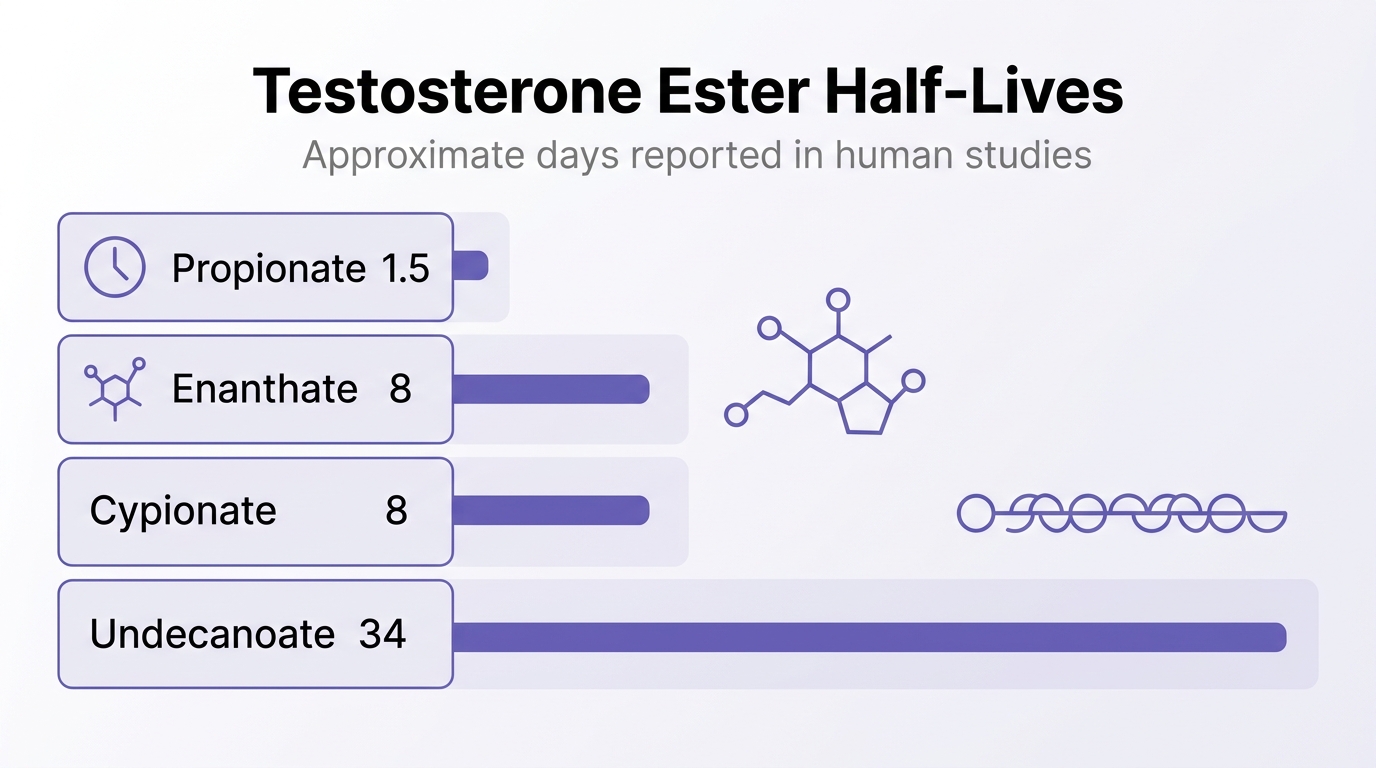
Reported half-lives differ widely between esters; the table below summarises the published figures and their sources.
Longer half-lives are linked to smoother blood levels, while shorter ones fluctuate more, which is what clinicians monitor during treatment of diagnosed hypogonadism (Farzam, 2026).
What a testosterone ester is
Testosterone is the primary male sex hormone and an agonist at the androgen receptor. It is produced mainly by the Leydig cells of the testes under luteinizing hormone signalling (Shanmuganathan et al., 2026). As a medicine, testosterone can be delivered by several routes, and injectable products usually contain an ester rather than the unmodified hormone.
An ester is a short fatty-acid chain bonded to the hormone molecule. Attaching the chain changes how readily the compound dissolves in the oil vehicle and slows its release after injection, a general feature of depot formulations rather than something unique to testosterone. The chain does not change which receptor the free hormone activates, because the same testosterone molecule is released once the chain is removed (Wiacek and Zubrzycki, 2026).
Why the body clears unmodified testosterone quickly
Unmodified testosterone is cleared from the circulation relatively quickly, so a plain injection of the hormone does not keep blood levels stable for long (Shanmuganathan et al., 2026). This is why delivery strategies that slow the release of the hormone have been developed (Lee et al., 2026). Esterification addresses the same problem by turning the injected oil into a depot from which the esterified hormone is absorbed gradually (Shanmuganathan et al., 2026). Slowing the release of an active drug from its injection site is a common strategy in pharmaceutical design, and this article treats it only as general pharmacology.
How the ester is removed in the body
After injection, the esterified hormone moves out of the depot and into the circulation, where enzymes that cleave ester bonds act on the link. This hydrolysis step is what keeps delivery gradual: the rate depends on how quickly the depot is absorbed and the chain is removed, not on the hormone itself. The enzymatic step is described here at a general level, because the sources used in this article focus on clinical pharmacokinetics rather than the specific esterase enzymes involved.
Reported half-lives for common esters
The table below summarises half-life figures reported for common esters. The values come from human studies and reviews, they are representative figures rather than fixed constants, and they vary between reports.
Ester | Reported half-life | Notes from the literature |
Testosterone propionate | About 1.5 days | The briefest half-life of the esters listed, with the ester measurable in plasma for roughly 36 hours in normal men (Fujioka et al., 1986) |
Testosterone enanthate | About 8 days | Similar pharmacokinetics to cypionate, with somewhat more variability between individuals (Shanmuganathan et al., 2026) |
Testosterone cypionate | About 8 days | Peak serum concentrations are reported between days 2 and 5, with concentrations falling to a trough around days 13 to 14 (Shanmuganathan et al., 2026) |
Testosterone undecanoate (injectable) | About 34 days | The longest reported half-life among the esters listed, with peak concentrations reported around day 7 and steady state typically reported after the third dose (Shanmuganathan et al., 2026) |
Release rate follows chain length: esters with shorter chains are released and cleared more quickly, while longer chains hold the hormone in the depot for longer. As a result, the same amount of hormone can produce different concentration curves over time depending on the ester (Farzam, 2026).
Why release rate matters: peaks, troughs and stability
Release rate sets how blood levels move between higher and lower values. When a short-acting ester is given at longer intervals, the difference between the peak after an administration and the level just before the next one can be substantial. A review of injectable testosterone therapy describes this pattern, in which some patients notice effects near peak levels and a return of hypogonadal symptoms as levels fall (Farzam, 2026). The same review notes that formulations or schedules that produce smoother exposure are associated with more stable levels, which is one reason release rate is taken into account when therapy is planned (Farzam, 2026). That swing between peaks and troughs is a pharmacokinetic property of release rate, not a sign that something was done incorrectly.
The review also notes that this peak-to-trough variation can make laboratory interpretation and safety monitoring harder, because a single measurement means little without knowing which ester is involved and when the sample was taken (Farzam, 2026). Reading those measurements, and deciding on any treatment, belongs to a treating clinician and depends on a confirmed diagnosis of hypogonadism, not on the ester alone.
What this evidence does and does not show
The figures in this article come from a small evidence base. Three of the four half-lives in the table are drawn from a single review (Shanmuganathan et al., 2026), and the human propionate figure dates from 1986 (Fujioka et al., 1986). Reported half-lives vary between sources, so the values should be read as representative figures rather than universal constants. The wider literature also mixes study types: clinical reviews and human studies sit alongside animal work, such as a study of silicone-based propionate implants in castrated pigs (Puda et al., 2026), which is not human data. This article describes the pharmacology at a general level and is not a guide to treatment.
How testosterone esters are regulated
How a testosterone product may be sold, and whether a prescription is required, differ by country. There is no single worldwide rule, and readers should check their national medicines regulator for the status that applies where they live.
Non-medical androgen use, meaning use without a medical diagnosis and outside medical supervision, is a separate matter. A position statement from the Society for Endocrinology notes that it is associated with cardiovascular disease, erythrocytosis, dyslipidaemia, infertility, sexual dysfunction, psychiatric effects and suppression of the hypothalamic-pituitary-gonadal axis (Grant et al., 2026). The same statement records that evidence on how to manage the consequences of such use remains limited (Grant et al., 2026).
FAQ
Do different testosterone esters work differently?
The main difference is release speed and how long blood levels stay elevated, not the identity of the hormone. Reported half-lives range from about one and a half days for propionate to roughly 34 days for injectable undecanoate (Fujioka et al., 1986; Shanmuganathan et al., 2026).
Does the ester change the hormone itself?
No. The ester is a removable chain. Enzymes act on the ester link, the chain comes off, and what remains is testosterone that is chemically identical regardless of which ester was used.
Why do short-acting esters fluctuate more?
Because they are absorbed and cleared quickly, blood levels rise and fall more quickly. A clinical review links this peak-to-trough variation with symptom cycling and with harder-to-read laboratory results in some patients (Farzam, 2026).
Are testosterone esters available for bodybuilding or performance use?
No. The medical use covered in this article is treatment of diagnosed hypogonadism, and there is no medical indication for bodybuilding or performance use. Non-medical androgen use is associated with significant health risks (Grant et al., 2026).
Disclaimer
This article is for information only and is not medical advice. It does not cover dosing, cycles or how to use these medicines. Consult a qualified healthcare professional about diagnosis and treatment.
Sources
Shanmuganathan G, Lyang N, Gill S, Agrawal DK. Testosterone and Cardiovascular Health: Physiology, Pharmacokinetics and Clinical Implications. Cardiol Cardiovasc Med. 2026;10:57-70. PMID 42064176. https://www.ncbi.nlm.nih.gov/pmc/articles/PMC13128135/
Farzam K. Individualizing Injectable Testosterone Replacement Therapy in Primary Care: Pharmacokinetics, Symptom Stability, Safety Monitoring, and Injection Frequency. Cureus. 2026;18:e110570. PMID 42292725. https://www.ncbi.nlm.nih.gov/pmc/articles/PMC13262958/
Fujioka M, Shinohara Y, Baba S, Irie M, Inoue K. Pharmacokinetic properties of testosterone propionate in normal men. J Clin Endocrinol Metab. 1986;63(6):1361-1364. PMID 3782423. https://pubmed.ncbi.nlm.nih.gov/3782423/
Puda ST, Moeser HA, Moeser AJ. Development and characterization of silicone-based testosterone propionate implants for sustained androgen delivery in juvenile castrated male pigs. MethodsX. 2026;17:104009. PMID 42382156. https://www.ncbi.nlm.nih.gov/pmc/articles/PMC13316705/
Lee CB, Tenora L, Zhang R, Ranjit A, Markowski MC, Slusher BS, Rais R. A Star-PEGylation Strategy to Improve Testosterone Pharmacokinetics. Molecules. 2026;31(1):198. PMID 41515493. https://www.ncbi.nlm.nih.gov/pmc/articles/PMC12787564/
Wiacek M, Zubrzycki IZ. Anabolic-Androgenic Steroids Revisited: Structural Biology, Receptor Signaling, and Mechanisms of Anabolic-Androgenic Dissociation. Int J Mol Sci. 2026;27(6):2581. PMID 41898445. https://www.ncbi.nlm.nih.gov/pmc/articles/PMC13026150/
Grant B, Jayasena CN, Nag S, Quinton R. Management of non-medical androgen use: a position statement by the Society for Endocrinology. Endocr Connect. 2026. PMID 42696286. https://www.ncbi.nlm.nih.gov/pmc/articles/PMC13641141/