

HGH and Aging: What the Evidence Actually Shows
Updated: Oct 12
By HGHThailand Team
Questions about HGH and aging usually start from one of two places: a diagnosed adult growth hormone deficiency, treated under specialist supervision, or curiosity about whether supplementing a hormone that naturally declines with age could slow aging itself. These are different situations with different evidence. This article covers where growth hormone therapy is actually used in medicine, and what controlled trials found when it was tested in healthy older adults without a diagnosed deficiency.
Key points
Growth hormone (GH) therapy is an approved, prescription-only treatment for adults with a medically confirmed GH deficiency, diagnosed by an endocrinologist using standardized stimulation testing.
The gradual decline in GH output that comes with normal aging, called the somatopause, is a separate physiological process, not a disease.
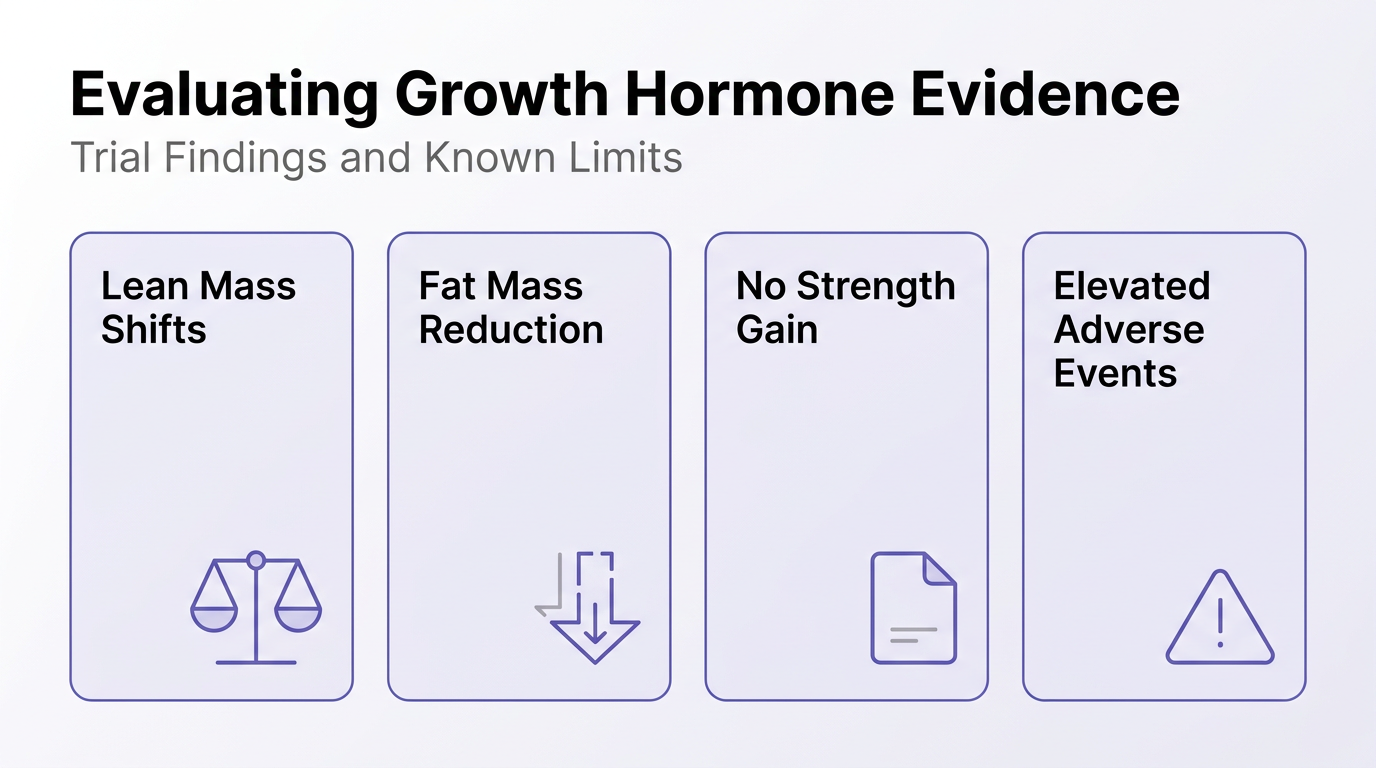
In healthy older adults without a diagnosed deficiency, trials found modest shifts in body composition (more lean mass, less fat) from GH, but mostly no significant improvement in strength or aerobic capacity.
One factorial trial found a marginal strength gain and a significant rise in oxygen uptake, but only in men who received GH combined with testosterone, not GH alone.
Adverse events, including fluid retention, joint pain, carpal tunnel symptoms, and impaired glucose tolerance, occurred significantly more often in GH-treated groups across these trials.
A 2007 systematic review concluded that GH "cannot be recommended as an antiaging therapy," and its use for that purpose is not approved by the FDA.
HGH and Aging: Understanding the Age-Related Decline
Human growth hormone (GH) is a peptide hormone synthesized and released in a pulsatile manner by the anterior pituitary gland. Understanding what human growth hormone is requires examining its endocrine pathway: pituitary release triggers downstream IGF-1 production in the liver and peripheral tissues, regulating protein synthesis, cellular maintenance, and substrate metabolism throughout the body.
Starting after early adulthood, daily growth hormone production declines at an estimated rate of roughly 14% to 15% per decade. Peak nocturnal secretory bursts become smaller and less frequent. By age 60, circulating levels of insulin-like growth factor 1 (IGF-1) in many healthy individuals drop below the reference ranges typical of young adults.
Researchers call this gradual decline the somatopause. Because it coincides with changes commonly seen in aging, such as reduced muscle mass (sarcopenia), increased visceral fat, and lower bone density, scientists in the late twentieth century hypothesized that falling hormone levels directly cause these changes. That hypothesis drove decades of research into whether supplemental GH could alter the physical course of aging in otherwise healthy people.
What early research uncovered: the 1990 Rudman study
Public interest in growth hormone and aging largely traces back to a 1990 trial led by Dr. Daniel Rudman, published in the *New England Journal of Medicine*. Investigators enrolled 21 healthy men aged 61 to 81 with baseline IGF-1 below 350 U per liter. Twelve received biosynthetic growth hormone for six months; nine received no treatment.
After six months, the treated group showed an 8.8% increase in lean body mass, a 14.4% decrease in fat mass, a 7.1% increase in skin thickness (borderline significant, P=0.07), and a 1.6% increase in lumbar bone density. The untreated group showed no significant change in any measure.
The authors concluded that diminished GH secretion partly explains the lean-mass loss, fat gain, and skin thinning seen with aging, but they did not test strength or stamina, and the trial involved only 21 men over a single six-month window. Despite those limits, media coverage over the following decade often presented the findings as proof that GH could reverse aging generally, a conclusion the study itself never made.
Systematic clinical evidence: body composition vs. functional capacity
To get a broader picture, researchers at Stanford University conducted a systematic review of GH trials in the healthy elderly, published in the *Annals of Internal Medicine* in 2007, combining 31 publications across 18 randomized, controlled study populations (220 participants on GH, mean age 69).
Measured Parameter | Finding (Liu et al., 2007) |
Lean body mass | Average increase of 2.1 kg (95% CI, 1.3 to 2.9 kg; P<0.001) |
Fat mass | Average reduction of 2.1 kg (95% CI, -2.8 to -1.35 kg; P<0.001) |
Body weight | No significant change (0.1 kg; 95% CI, -0.7 to 0.8) |
Total cholesterol | Reduced by 0.29 mmol/L, not significant after adjusting for body composition change |
Bone density and other lipid levels | No significant change |
The review's authors noted that lean mass gains like these partly reflect fluid retention rather than new contractile muscle, since GH stimulates sodium and water retention in connective tissue. A separate 26-week trial led by Dr. Marc Blackman, published in *JAMA*, tested this directly in adults aged 65 to 88, giving participants GH, a sex steroid (testosterone in men, hormone therapy in women), both, or placebo. Lean mass rose and fat mass fell across active-treatment groups, consistent with the systematic review. Strength and oxygen uptake did not improve significantly with GH alone in either sex. The one exception: men who received GH together with testosterone showed a significant rise in oxygen uptake (P<0.001) and a marginal 13.5 kg strength gain (P=0.05), an effect not seen with either hormone alone. Women on GH, with or without hormone therapy, showed no significant change in strength or endurance.
Taken together, the two trials point to the same conclusion for GH used on its own in healthy older adults: measurable body composition changes, but no reliable improvement in strength or aerobic capacity.
Documented side effects and clinical risks
Because healthy older adults do not have an underlying GH deficiency, giving them exogenous hormone pushes circulating levels above what their bodies would normally produce, stressing peripheral tissues and the cardiovascular system. Across the Liu 2007 review and the Blackman trial, adverse events were consistently more common in GH-treated groups than in controls:
Soft tissue edema: 39% of women on GH alone and 38% on GH plus hormone therapy in the Blackman trial, versus 0% on placebo; the Liu review separately confirmed edema was significantly more likely with GH, without a pooled percentage.
Arthralgia and joint stiffness: 41% of men on GH versus 0% on placebo in the Blackman trial; the Liu review found the same pattern.
Carpal tunnel syndrome: Fluid accumulation within the wrist compresses the median nerve, causing pain and numbness; 32% of men on GH plus testosterone in the Blackman trial versus 0% on placebo, and significantly more common with GH in the Liu review.
Glucose dysregulation: GH acts as a functional antagonist to insulin. In the Blackman trial, 18 of the GH-treated men developed diabetes or glucose intolerance versus 7 not on GH (P=0.006); the Liu review found a similar, somewhat elevated pattern.
Gynecomastia: Significantly more common with GH, per the Liu review.
Long-term safety is a separate, ongoing area of research. A 2021 review by Dr. Andrzej Bartke and colleagues, examining GH's effects on DNA repair, DNA methylation, and adipose tissue metabolism, concludes GH signaling is "consistent with GH promoting aging and cancer progression" in the mechanisms studied. This aligns with broader animal research linking reduced GH/IGF-1 signaling to extended lifespan in several species, though the long-term cancer implications for GH therapy in humans remain under study.
Where growth hormone therapy fits in medicine today
None of the trials above are about the approved use of GH. Recombinant human growth hormone is approved in major jurisdictions, including the United States, for specific diagnosed conditions: confirmed adult GH deficiency, childhood growth disorders, and wasting syndromes linked to severe systemic disease. As the Liu 2007 review states plainly, GH's use as an antiaging therapy "has not been approved by the U.S. Food and Drug Administration," and distributing it for that purpose is illegal in the United States. Its overall conclusion, after pooling the available trial data in the healthy elderly, was direct: GH "cannot be recommended as an antiaging therapy."
That leaves growth hormone deficiency care in the hands of specialists treating a confirmed medical condition, a different context from supplementing GH to counter ordinary age-related decline.
How adult growth hormone deficiency is diagnosed and monitored
The Endocrine Society's 2011 clinical practice guideline on adult GH deficiency describes how this diagnosis is handled in practice, and it is worth understanding even if you are only curious rather than symptomatic. According to the guideline, GH deficiency can either persist from childhood or develop later in life, usually from damage to the pituitary gland or hypothalamus (tumors, surgery, radiation, or trauma). Confirming it is not simple: unless someone has a clear, previously documented genetic or structural cause, diagnosis requires standardized provocative stimulation testing, not just a low IGF-1 reading on a routine blood panel.
The guideline notes that GH therapy offers benefits in body composition, exercise capacity, skeletal integrity, and quality-of-life measures specifically in patients with this confirmed, more severe deficiency, and that the associated risks are low in that population. It is explicit that the decision to treat is individualized, weighing benefits and risks for each patient under ongoing clinical supervision, which in practice means regular follow-up and laboratory monitoring to track response and catch problems early. None of this guidance extends to people with normal, age-related hormone decline; the guideline's scope is diagnosed deficiency, not the somatopause.
Questions to ask your doctor
If you are wondering whether your symptoms might reflect a genuine GH deficiency, or you are simply curious after reading research like this, an endocrinologist is the right specialist to ask. Useful questions include:
What specific tests would confirm or rule out a true GH deficiency, and why is more than one test often necessary?
Given my health history, what would the realistic benefits and risks of treatment be if a deficiency were confirmed?
How would you monitor my IGF-1 levels and overall response if treatment were started?
What symptoms should prompt me to contact you between scheduled visits?
How is normal age-related hormone decline distinguished from a diagnosable deficiency in someone my age?
These are informational starting points for a conversation with a qualified physician, not a substitute for one.
Frequently asked questions
Can growth hormone therapy reverse human aging?
No. Clinical trials in healthy older adults show that GH does not stop or reverse biological aging. It can produce modest shifts in lean body mass and fat distribution, but it has not been shown to extend lifespan or rejuvenate organs, and major reviews do not recommend it as an anti-aging intervention.
Does increased lean mass from GH translate into greater strength in older adults?
Generally, no, when GH is given alone. The 2007 systematic review and the Blackman trial both found that healthy older adults on GH gained lean mass without a matching gain in strength or aerobic capacity. The one exception was men who received GH together with testosterone, who showed a marginal strength gain and a significant rise in oxygen uptake, an effect not seen with either hormone alone.
What are the main risks identified in trials of GH in healthy older adults?
Trials and systematic reviews found significantly higher rates of soft tissue edema, joint pain (arthralgia), carpal tunnel syndrome, and gynecomastia in GH-treated groups, along with a higher incidence of impaired glucose tolerance and new-onset diabetes.
How is adult growth hormone deficiency diagnosed, and how is that different from the somatopause?
The Endocrine Society's guideline requires standardized stimulation testing (absent a known prior genetic or structural cause) before diagnosing adult GH deficiency, and treatment is managed and monitored by a specialist. The somatopause, by contrast, is the normal, gradual decline in GH output that comes with aging; it is not classified as a disease, and the guideline's recommendations do not extend to treating it.
Sources
Rudman D, Feller AG, Nagraj HS, et al. Effects of human growth hormone in men over 60 years old. *New England Journal of Medicine*. 1990;323(1):1-6. doi:10.1056/NEJM199007053230101. PMID: 2355952.
Blackman MR, Sorkin JD, Münzer T, et al. Growth hormone and sex steroid administration in healthy aged women and men: a randomized controlled trial. *JAMA*. 2002;288(18):2282-2292. doi:10.1001/jama.288.18.2282. PMID: 12425705.
Liu H, Bravata DM, Olkin I, et al. Systematic review: the safety and efficacy of growth hormone in the healthy elderly. *Annals of Internal Medicine*. 2007;146(2):104-115. doi:10.7326/0003-4819-146-2-200701160-00005. PMID: 17227934.
Molitch ME, Clemmons DR, Malozowski S, et al. Evaluation and treatment of adult growth hormone deficiency: an Endocrine Society clinical practice guideline. *Journal of Clinical Endocrinology & Metabolism*. 2011;96(6):1587-1609. doi:10.1210/jc.2011-0179. PMID: 21602453.
Bartke A, Hascup E, Hascup K, Masternak MM. Growth Hormone and Aging: New Findings. *World Journal of Men's Health*. 2021;39(3):454-465. doi:10.5534/wjmh.200201. PMID: 33663025. ---