

Muscle Building Diets: What the Evidence Says
Updated: 1 day ago
By HGHThailand Team
Muscle building diets work mainly through two fundamentals: taking in enough total energy and eating enough protein. The rest, including meal frequency, specific food combinations and the precise timing of meals, appears to matter far less than most diet marketing suggests.
Key points
Muscle gain is driven by a sustained positive energy balance, meaning more energy is taken in than is expended over time.
Published guidance places daily protein for exercising adults at roughly 1.4 to 2.0 g per kg of body weight.
A large meta-analysis found that protein intakes above about 1.6 g/kg/day did not add further gains in fat-free mass.
Meal timing appears to be a secondary factor; the classic 30-minute "anabolic window" is not a strict deadline.
Carbohydrate supports training quality and glycogen stores, particularly during high-volume training.
What a muscle building diet actually is
At its core, a muscle building diet is a way of eating that supplies enough energy and enough protein to support resistance-training adaptations. Muscle tissue is built from amino acids, and the process of building and repairing muscle costs energy. A position stand from the International Society of Sports Nutrition (ISSN) on diets and body composition describes diets aimed at accruing lean mass as being driven by a sustained caloric surplus, which supports increasing resistance-training demands (Aragon et al., 2017). The same document notes that very low-calorie diets are used primarily for fat loss, and that slower rates of weight loss tend to preserve lean mass better in leaner people.
This is why growth phases and fat-loss phases look different. During fat loss the emphasis is on preserving muscle while reducing body fat, whereas during growth it shifts to adding tissue, and the two call for different energy intakes. Once energy intake is adequate, the open questions are how much protein is involved, how it is distributed and whether the timing of meals around training changes the outcome. Each has a research base, and the answers are narrower than the claims often made for them.
How much protein do you need to build muscle?
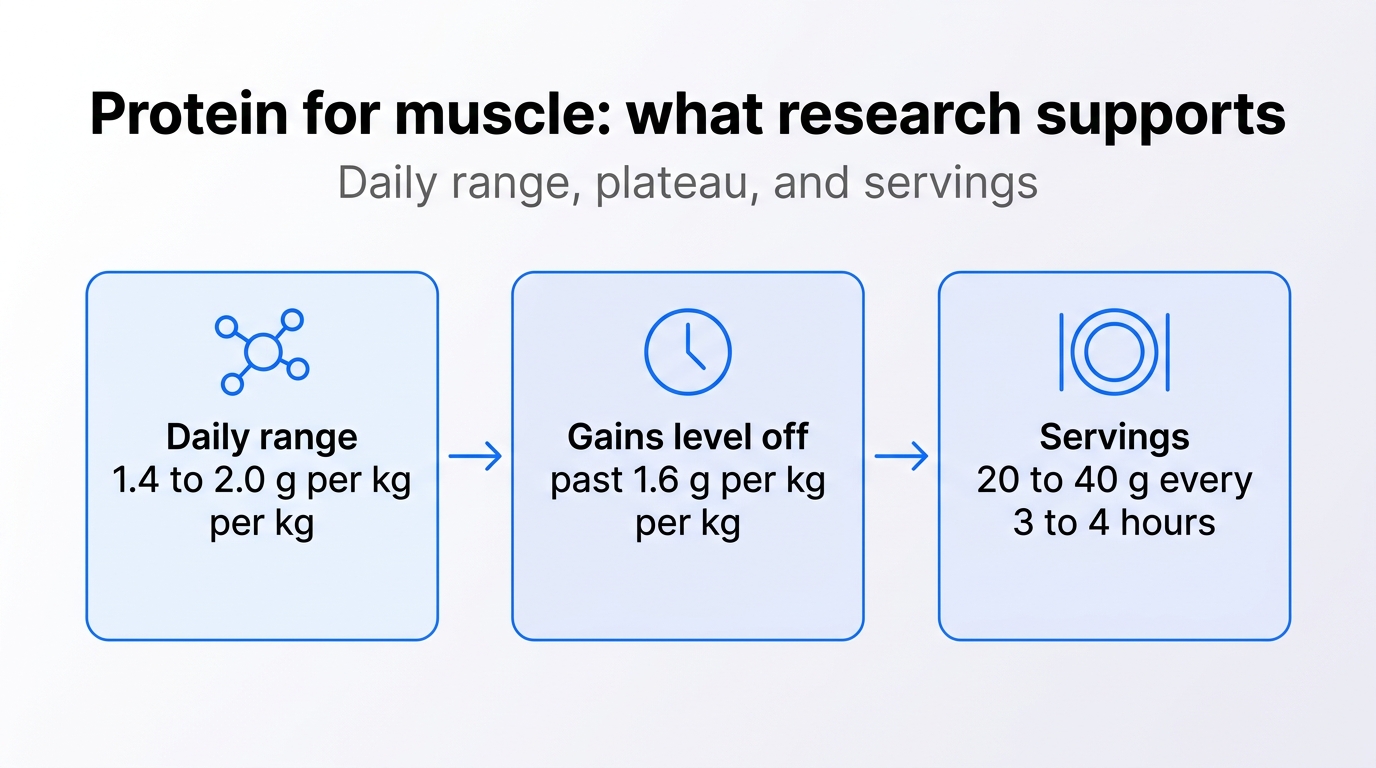
Protein is the nutrient most closely tied to muscle growth, and for exercising adults the daily range is reasonably well established. The ISSN position stand on protein and exercise states that, for building and maintaining muscle mass, an overall daily intake of 1.4 to 2.0 g of protein per kg of body weight per day is sufficient for most exercising individuals (Jäger et al., 2017).
The upper end of that range is not a level everyone needs to reach. A systematic review, meta-analysis and meta-regression of 49 randomised controlled trials with 1,863 participants found that protein supplementation increased fat-free mass by a mean of 0.30 kg on top of resistance training, and that total protein intakes above about 1.6 g/kg/day did not produce further gains in fat-free mass (Morton et al., 2018).
The same ISSN position stand notes that higher intakes, in the region of 2.3 to 3.1 g/kg/day, may be needed to preserve lean mass during low-calorie periods, when the goal is retention rather than growth (Jäger et al., 2017). What intake is used in practice therefore depends on the goal and the energy intake, not on a single universal rule.
Protein per meal and across the day
Total daily protein matters most, but how it is distributed has a supporting role. The ISSN position stand describes a serving of about 0.25 g of high-quality protein per kg of body weight, or an absolute amount of 20 to 40 g, and states that such servings are ideally distributed every three to four hours across the day; each serving should contain about 700 to 3,000 mg of the amino acid leucine along with a full set of essential amino acids (Jäger et al., 2017).
Three points follow from the research. First, a single large protein meal does not compensate for a low daily total. Second, the position stand does not require a fixed number of meals; the emphasis is on even, adequate servings. Third, protein quality matters, and the ISSN notes that whole-food sources containing all the essential amino acids are the preferred foundation (Jäger et al., 2017). For people who struggle to reach their daily intake from food alone, the same position stand describes protein supplements as a practical way to ensure adequate protein quality and quantity, not as a requirement (Jäger et al., 2017).
Does meal timing matter? Looking at the anabolic window
The idea of a short post-exercise "window of opportunity" has been widely repeated, but research treats it as less rigid than a deadline. A review titled "Nutrient timing revisited: is there a post-exercise anabolic window?" examined the literature on eating around training and noted that the importance, and even the existence, of a post-exercise window varies with factors such as whether the previous meal was eaten close to training (Aragon and Schoenfeld, 2013).
The ISSN nutrient timing position stand takes a similar view: pre- and post-exercise nutrition can support strength and body composition, but the size and timing of the pre-exercise meal change how much the post-exercise meal matters, and the anabolic effect of exercise lasts at least 24 hours (Kerksick et al., 2017). Aragon and Schoenfeld suggest that total daily intake and consistency carry most of the weight, and that the timing of protein around training is a secondary factor rather than a make-or-break element.
What is the role of carbohydrate?
Carbohydrate is the main fuel for hard resistance training and for replenishing muscle glycogen, the stored form of glucose that powers repeated efforts. The ISSN nutrient timing position stand states that endogenous glycogen stores are maximised by a high-carbohydrate diet of 8 to 12 g of carbohydrate per kg of body weight per day, a figure drawn from studies of athletes performing demanding or repeated training sessions, and that carbohydrate consumed around resistance exercise can support glycogen stores and training adaptations (Kerksick et al., 2017).
For recreational lifters, the practical implication drawn in the research is that adequate carbohydrate supports training quality, especially during frequent or high-volume sessions. The position stand does not identify a specific moment at which carbohydrate becomes essential, nor a required ratio of carbohydrate to protein around training. In the studies reviewed, carbohydrate functions as a fuel for the training that drives adaptation.
Do macronutrient ratios and meal frequency matter?
Marketing often presents muscle building diets as a strict formula: a fixed ratio of protein, carbohydrate and fat, a set number of meals, or a list of approved foods. The research base described in the ISSN position stands is more permissive. The nutrient timing review reports that changing meal frequency has shown limited impact on body composition in the settings studied, while appetite and satiety respond more reliably (Kerksick et al., 2017). Total energy and total protein remain the dominant variables.
Adequate fat is part of a sound diet, and the ISSN notes that a wide range of dietary approaches, from low-fat to low-carbohydrate, can be similarly effective for body composition (Aragon et al., 2017). The position stands reviewed here emphasise total energy and total protein rather than particular foods or combinations, so claims built on novelty sit outside what resistance-training nutrition research describes.
What the research says, and its limits
The evidence here rests on systematic reviews and society position stands rather than single small studies. The Morton meta-analysis pooled 49 randomised controlled trials with 1,863 participants, a solid base for the protein finding that gains level off beyond about 1.6 g/kg/day. In the same analysis, the effect of protein supplementation on fat-free mass gains was smaller with increasing age and larger in resistance-trained individuals (Morton et al., 2018). The ISSN position stands are consensus documents that weigh many studies (Jäger et al., 2017; Kerksick et al., 2017; Aragon et al., 2017).
The limits matter. The sources cited here date from 2013 to 2018, most are reviews rather than new trials, and several are position stands from the same society, so the base is narrower than the length of this article might suggest. Individual responses to diet vary with age, training experience, energy intake and goals, and nutrient-timing findings are hard to generalise because the value of eating around training depends on what was eaten before. Each figure is best read as a summary of the studies behind it, not as a law.
What the evidence supports in practice
Read together, the studies describe a consistent pattern rather than a set of rules:
Energy intakes in growth phases have been set above maintenance to support tissue gain, with the exact surplus treated as individual and judged over weeks rather than days (Aragon et al., 2017).
Protein intakes reported in this literature cluster around 1.4 to 2.0 g/kg/day, with benefits to fat-free mass appearing to level off near 1.6 g/kg/day (Jäger et al., 2017; Morton et al., 2018).
Protein distribution studies have used servings of about 0.25 g/kg, or 20 to 40 g, spread across the day rather than concentrated in one meal (Jäger et al., 2017).
Carbohydrate intakes in the research have ranged widely; adequate carbohydrate is associated with training quality and glycogen availability (Kerksick et al., 2017).
Meal frequency has shown limited effect on body composition in the studied settings, so daily consistency has drawn more support than a fixed schedule (Kerksick et al., 2017).
FAQ
How much protein do I need to build muscle?
The ISSN protein position stand places the daily intake for exercising adults at about 1.4 to 2.0 g of protein per kg of body weight. A meta-analysis of 49 trials found that gains in fat-free mass levelled off beyond about 1.6 g/kg/day (Jäger et al., 2017; Morton et al., 2018).
Is there a 30-minute anabolic window after training?
Not as a strict deadline. A review of nutrient-timing research found that the value of post-exercise eating depends on when food was last eaten, and the anabolic effect of exercise lasts at least 24 hours (Aragon and Schoenfeld, 2013; Kerksick et al., 2017). Total daily intake matters more.
Do I need carbohydrate to build muscle?
Carbohydrate is the main fuel for hard resistance training and for glycogen. The ISSN reports that glycogen stores are maximised on a high-carbohydrate diet of 8 to 12 g/kg/day in demanding training, and that carbohydrate supports training quality rather than needing to be timed to a fixed moment (Kerksick et al., 2017).
Do I need to eat six small meals a day?
The ISSN reports that meal frequency has shown limited impact on body composition in the settings studied, while appetite and satiety respond more reliably (Kerksick et al., 2017). Even protein servings across the day appear to matter more than a fixed number of meals.
Are special foods or food combinations necessary?
The position stands reviewed here emphasise total energy and total protein rather than particular foods or combinations, and describe a wide range of dietary approaches as similarly effective for body composition (Aragon et al., 2017).
Disclaimer
This article is for general information only and is not medical advice. It does not diagnose or treat any condition. Nutritional needs vary, and a qualified healthcare professional such as a registered dietitian or physician can offer personal guidance. Statements about research describe published findings and their limitations.
Sources
Aragon AA, Schoenfeld BJ. "Nutrient timing revisited: is there a post-exercise anabolic window?" Journal of the International Society of Sports Nutrition. 2013;10:5. https://pubmed.ncbi.nlm.nih.gov/23360586/
Aragon AA, Schoenfeld BJ, Wildman R, et al. "International society of sports nutrition position stand: diets and body composition." Journal of the International Society of Sports Nutrition. 2017;14:16. https://pubmed.ncbi.nlm.nih.gov/28630601/
Jäger R, Kerksick CM, Campbell BI, et al. "International Society of Sports Nutrition Position Stand: protein and exercise." Journal of the International Society of Sports Nutrition. 2017;14:20. https://pubmed.ncbi.nlm.nih.gov/28642676/
Kerksick CM, Arent S, Schoenfeld BJ, et al. "International society of sports nutrition position stand: nutrient timing." Journal of the International Society of Sports Nutrition. 2017;14:33. https://pubmed.ncbi.nlm.nih.gov/28919842/
Morton RW, Murphy KT, McKellar SR, et al. "A systematic review, meta-analysis and meta-regression of the effect of protein supplementation on resistance training-induced gains in muscle mass and strength in healthy adults." British Journal of Sports Medicine. 2018;52(6):376-384. https://pubmed.ncbi.nlm.nih.gov/28698222/