

Low HGH and Anxiety: Does Growth Hormone Affect Mood?
Updated: Oct 12
By HGHThailand Team
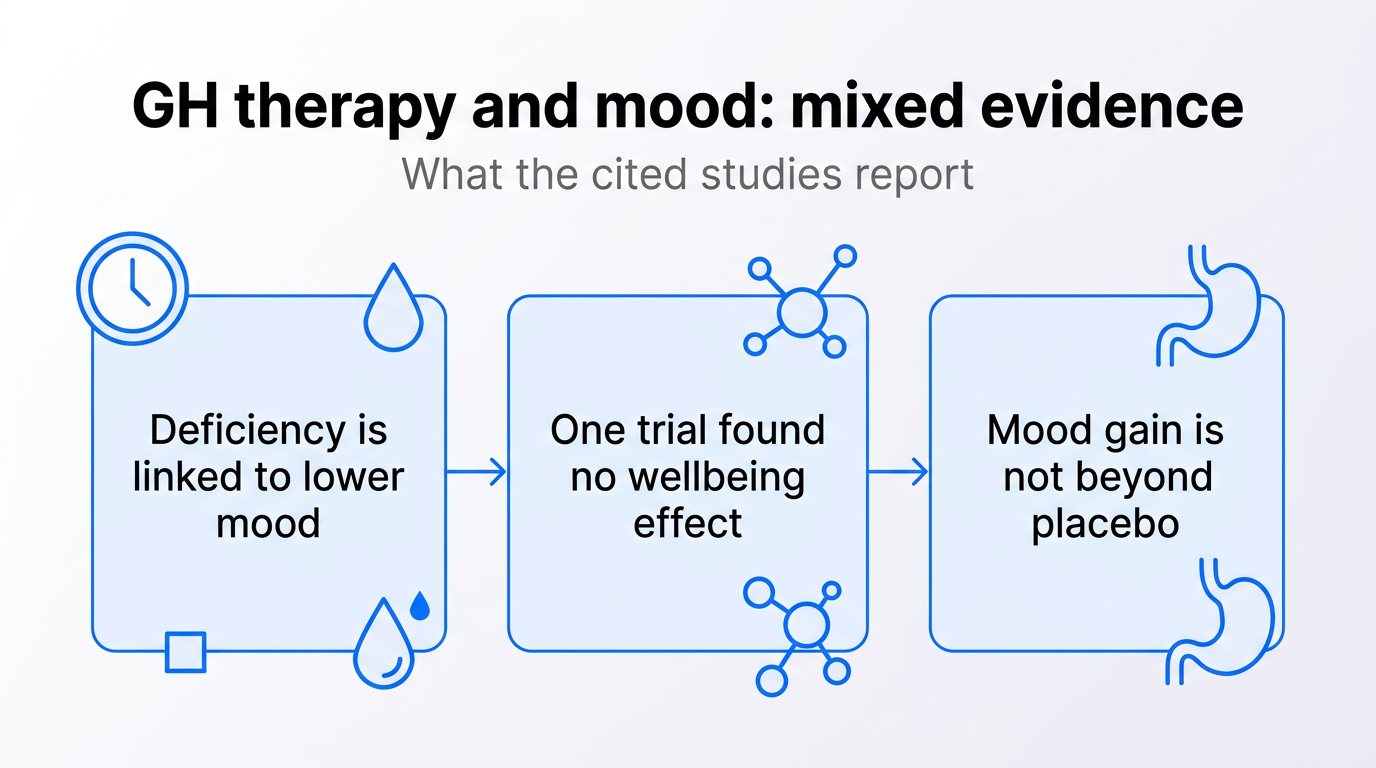
Many people exploring endocrine health ask whether low HGH and anxiety are directly connected. The evidence points to an association rather than a cause. Growth hormone deficiency (GHD) is linked to lower mood and reduced well-being in adults, but the evidence that growth hormone (GH) therapy relieves anxiety is weak and mixed. One randomised trial found no improvement in psychological well-being. Anxiety is a separate condition that needs its own assessment and treatment, not a hormone deficiency.
Key points
Adults with diagnosed growth hormone deficiency often report lower mood, energy and well-being.
Studies of GH replacement on mood have produced inconsistent results; at least one placebo-controlled trial found no effect on psychological well-being.
Most of these studies were not designed to test anxiety, and their samples were small.
Anxiety disorders are common and are assessed and treated by qualified clinicians, not with growth hormone.
Suspected hormone deficiency should be diagnosed by a doctor, never self-diagnosed or self-treated.
What "low HGH" actually means
Growth hormone (GH) is a protein hormone made in the anterior pituitary gland, a small structure at the base of the brain. It is released in pulses and acts both directly and through insulin-like growth factor 1 (IGF-1), which the liver produces in response to GH. Growth hormone affects body composition, metabolism and tissue growth. If you want the basics first, our guide What is HGH? explains how the hormone is produced and what it does.
Normal Age-Related Decline vs. Clinical Deficiency
Two different things are often described as "low HGH":
Age-related decline. Spontaneous and stimulated GH secretion, and circulating IGF-1, fall steadily with advancing age (Corpas, Harman & Blackman, *Endocrine Reviews*, 1993). This is a normal trend, not a disease.
Growth hormone deficiency (GHD). A clinical diagnosis made by an endocrinologist, based on a below-normal GH response to stimulation tests in a person who also has pituitary disease or other pituitary hormone deficiencies (Monson, Brooke & Akker, *Endotext*, 2015). The main adult growth hormone deficiency symptoms can include reduced exercise tolerance, decreased mood and reduced general well-being.
The distinction matters. The studies discussed below looked at people with a diagnosed deficiency, not at healthy adults whose GH is simply at the lower end of normal for their age. The normal age-related decline is covered in more detail in HGH and the body's own growth hormone. The prescription form of the hormone is somatropin, described in our somatotropin preparations category.
HGH and Mood: Is Low Growth Hormone Linked to Anxiety?
There is a consistent observational link between diagnosed GHD and lower mood. A review in *Treatments in Endocrinology* notes that GH-deficient patients commonly experience "emotional instability, reduced energy, sleep disturbances, and problems with (sexual) relationships" (Deijen & Arwert, 2006). The adult GHD syndrome is characterised by decreased mood and decreased general well-being, and reduced psychological well-being and quality of life are recognised as major reasons patients seek treatment (Monson et al., 2015).
A separate review found that adults with pituitary disease and GHD have impaired physical and psychological functioning, including reduced quality of life, but concluded that the relationship between quality of life and depressed mood "is complex and needs further study" (McGauley, *Growth Hormone & IGF Research*, 2000).
What these findings show is an association: people with a diagnosed hormone deficiency often also report low mood. They do not show that low GH causes anxiety, and they do not establish that raising GH will remove it. Evidence that looks specifically at growth hormone deficiency anxiety is limited, because most studies were built around broader well-being and quality-of-life measures rather than anxiety itself.
Does GH therapy reduce anxiety? What the trials show
Most evidence on growth hormone therapy quality of life comes from small trials with inconsistent results. The trial evidence on HGH therapy anxiety is mixed.
The Deijen Placebo-Controlled Trial
A randomised, placebo-controlled trial found no effect on well-being. In a two-year study of 48 adult men with childhood-onset GHD, researchers measured state and trait anxiety among other psychological outcomes alongside GH replacement. Memory function improved, but the authors concluded that GH replacement "has no effect on psychological well-being or perceptual-motor skill" (Deijen, de Boer & van der Veen, *Psychoneuroendocrinology*, 1998).
Meta-Analyses on Psychological Well-Being
A meta-analysis found improvement over time, but not clearly from the drug itself. Pooled data showed mood status improving at 3, 6 and 12 months versus baseline, but with shrinking effect sizes over time, and the median treatment period of about six months "did not improve mood status more than placebo" (Deijen & Arwert, 2006). When questionnaires were grouped by what they measured, GH replacement showed a medium effect on well-being and only a small effect on quality of life, but those analyses could not be compared with placebo. The review concluded that GH treatment "most likely plays a role" in well-being, based partly on correlations between IGF-1 levels and measures of anxiety and depression.
Reviews describe the results as inconsistent. One review of quality-of-life studies noted that although most trials report improvement with GH replacement, "the results are not consistent" (McGauley, 2000).
In people with a confirmed deficiency, GH replacement may improve some aspects of well-being, which is a legitimate question to raise with a doctor; the wider clinical picture is covered in our overview of what HGH therapy can help with. But there is no reliable, placebo-controlled evidence that GH therapy treats anxiety, and the one randomised trial that measured anxiety-type outcomes directly found no benefit to psychological well-being.
Why the evidence is weak and mixed
Several study-design issues explain the uncertainty:
Different tools measure different things. "Quality of life", "health status" and "well-being" are not interchangeable; well-being questionnaires are the ones that capture anxiety, depression and energy, while quality-of-life scales emphasise mental health and health-status scales emphasise physical function (Deijen & Arwert, 2006).
Small samples and mixed groups. Study populations are small, and results may differ between people with isolated GH deficiency and those with several pituitary hormone deficiencies (Deijen & Arwert, 2006).
Anxiety was rarely the main endpoint. Most trials were not designed to test anxiety specifically, so any anxiety signal is secondary and easy to over-read.
Baseline improvements can mislead. Mood tends to improve in both treated and untreated groups over time; without a placebo comparison, that change cannot be attributed to the hormone (Deijen & Arwert, 2006).
Anxiety is not a hormone deficiency
Anxiety disorders are common: the National Institute of Mental Health (NIMH) notes that about a third of U.S. adolescents and adults experience an anxiety disorder at some point in their lives, and that symptoms can interfere with work, study and relationships. They are diagnosed and treated by qualified clinicians. Growth hormone is a prescription medicine used to treat diagnosed growth hormone deficiency; it is not a treatment for anxiety.
If you have persistent anxiety, the useful next step is a doctor or mental-health professional, not a hormone product. If you also have symptoms that could point to GHD (long-standing fatigue, changes in body composition, or a history of pituitary problems), an endocrinologist can assess that separately with proper testing.
Questions to ask your doctor
Could my symptoms come from an anxiety disorder, a hormone problem, or both?
What tests would confirm or rule out growth hormone deficiency, and who interprets them?
If I do have GHD, what can treatment realistically change, and what can't it?
How will we measure whether my mood or well-being actually improves?
Should I also see a mental-health professional for the anxiety itself?
FAQ
Can low HGH cause anxiety?
The research shows an association, not a cause. Adults with diagnosed growth hormone deficiency often report lower mood and well-being, but no study cited here shows that low GH causes an anxiety disorder. Many other factors affect anxiety.
Does HGH therapy help anxiety?
The evidence is weak and mixed. A randomised trial found GH replacement had no effect on psychological well-being, and a meta-analysis found mood improved over time but not more than placebo at around six months. There is no reliable evidence that GH therapy treats anxiety.
Is HGH used to treat anxiety?
No. Growth hormone is a prescription medicine for diagnosed growth hormone deficiency, not an anxiety treatment. Anxiety disorders are assessed and managed by qualified clinicians.
How is growth hormone deficiency diagnosed?
By an endocrinologist, using stimulation tests that measure the GH response, together with evidence of pituitary disease or other pituitary hormone deficiencies (Monson et al., 2015). It is not diagnosed from a single random blood level.
Do HGH levels naturally decline with age?
Yes. Spontaneous and stimulated GH secretion, and IGF-1 levels, decrease with advancing age (Corpas et al., 1993). This normal decline is different from a clinical growth hormone deficiency.
Disclaimer
This article is for general information only and is not medical advice. It does not diagnose or treat any condition, and nothing here should be used to decide about medicines. Anxiety and possible hormone problems should be assessed by a qualified healthcare professional. Statements about research describe published findings and their limitations; they are not recommendations.
Sources
Monson JP, Brooke AM, Akker S. "Adult Growth Hormone Deficiency." Endotext [Internet]. MDText.com, Inc., South Dartmouth (MA); 2015. Bookshelf ID NBK278982. https://www.ncbi.nlm.nih.gov/books/NBK278982/ (PMID 25905216)
Deijen JB, Arwert LI. "Impaired quality of life in hypopituitary adults with growth hormone deficiency: can somatropin replacement therapy help?" Treatments in Endocrinology. 2006;5(4):243–250. https://pubmed.ncbi.nlm.nih.gov/16879003/
Deijen JB, de Boer H, van der Veen EA. "Cognitive changes during growth hormone replacement in adult men." Psychoneuroendocrinology. 1998;23(1):45–55. https://pubmed.ncbi.nlm.nih.gov/9618751/
McGauley G. "The psychological consequences and quality of life in adults with growth hormone deficiency." Growth Hormone & IGF Research. 2000;10 Suppl B:S63–68. https://pubmed.ncbi.nlm.nih.gov/10984256/
Corpas E, Harman SM, Blackman MR. "Human growth hormone and human aging." Endocrine Reviews. 1993;14(1):20–39. https://pubmed.ncbi.nlm.nih.gov/8491152/
National Institute of Mental Health. "Anxiety Disorders." https://www.nimh.nih.gov/health/topics/anxiety-disorders ---