

Training Supplements: Which Have the Best Evidence?
Updated: 3 days ago
By HGHThailand Team
Six supplements come up repeatedly in sports-nutrition research: creatine monohydrate, protein and whey, caffeine, beta-alanine, dietary nitrate from beetroot, and sodium bicarbonate. Each has a reported effect size and clear limits, and the evidence is task-specific. BCAAs are the clearest exception: the claim attached to them has little direct support.
Key points
Six supplements have human trial data summarised in position stands and meta-analyses: creatine, protein, caffeine, beta-alanine, nitrate and bicarbonate.
The evidence is task-specific. A supplement that helps one type of effort may do little for another.
Reported effect sizes are usually small to moderate rather than dramatic.
The sources lean heavily on the consensus of a single society, and the newest cited study is from 2023.
How this article judges the evidence
Two kinds of source carry the most weight here. The first is a position stand from the International Society of Sports Nutrition (ISSN), a consensus statement from a single professional society. The second is a peer-reviewed meta-analysis, which pools many trials and reports an average effect.
The limits of those sources matter as much as the results. Findings from one population or one type of task do not automatically transfer to another, and different studies measure different things, which is why the same supplement can look strong in one review and modest in another. Five of the ten sources cited here are ISSN position stands, so this article leans on one society's consensus, and the newest source dates from 2023. Where a figure is given, the source behind it is named so a reader can weigh it directly.
Creatine monohydrate
Creatine monohydrate has a broad base of human trial data. The ISSN position stand on creatine (Kreider et al., 2017) reports that supplementation raises intramuscular creatine concentrations and links this to improvements in high-intensity exercise and to greater training adaptations, with possible benefits for post-exercise recovery.
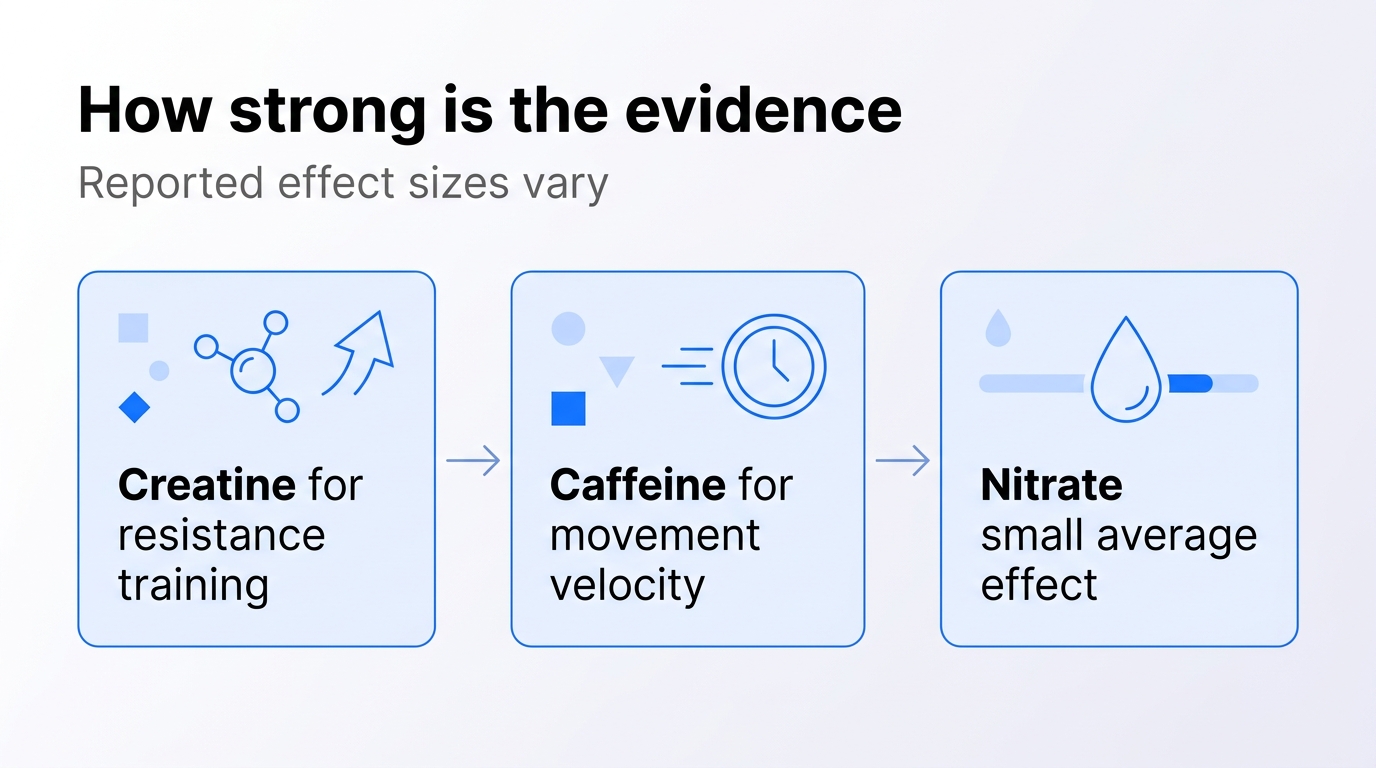
Meta-analyses help to size that up. Chilibeck et al. (2017) pooled 22 trials in older adults and reported that creatine plus resistance training produced greater gains in lean tissue mass (a mean difference of 1.37 kg) and in chest-press and leg-press strength (standardised mean differences of 0.35 and 0.24) than resistance training alone. Burke et al. (2023) pooled imaging-based studies in a mixed population and found a small positive effect on muscle hypertrophy (a pooled estimate of 0.11).
The limitation: the hypertrophy signal is small, and the older-adult population in one of the meta-analyses means the size of the benefit in young, trained lifters is less certain.
Protein and whey
Protein matters less as a performance aid than as a way to reach a daily requirement. The ISSN position stand on protein and exercise (Jäger et al., 2017) concludes that exercising people need more daily protein than sedentary adults, that higher intakes can help preserve lean mass during a calorie deficit, and that rapidly digested, high-quality proteins with a full essential amino acid profile are most effective for stimulating muscle protein synthesis. It also notes that whole foods can meet these targets.
The limitation: the optimal amount per serving is still debated, and the response depends on age and on how recently a person trained.
Caffeine
The ISSN position stand on caffeine and exercise performance (Guest et al., 2021) reports small to moderate benefits across muscular endurance, strength, sprinting, jumping and aerobic performance, with aerobic endurance showing the most consistent benefit of the outcomes reviewed. It notes that higher intakes are linked to more side effects without added benefit. Responses vary with genetics, habitual intake, sleep disruption and anxiety.
Raya-González et al. (2020) pooled studies of resistance exercise and found that caffeine improved movement velocity, while noting that earlier meta-analyses for strength and endurance reported smaller effects. In short, the effect is real but uneven across outcomes and across people.
Beta-alanine
Beta-alanine works through muscle carnosine, an internal buffer against acid. The ISSN position stand on beta-alanine (Trexler et al., 2015) concludes that sustained beta-alanine supplementation raises muscle carnosine and that this can improve performance in open-ended tasks and time trials of roughly one to four minutes. Paraesthesia, a tingling sensation, is a commonly reported effect of supplementation.
The limitation: benefits for maximal strength and for longer efforts are not well established.
Dietary nitrate from beetroot
Beetroot juice is a common source of dietary nitrate. Silva et al. (2022) pooled 123 studies and 1,705 participants and found an overall small benefit for exercise performance (a pooled standardised mean difference of 0.101). The effect was strongest for efforts lasting roughly two to ten minutes, and beetroot juice was more effective than nitrate salts. The review also found that things which reduce mouth bacteria, such as antibacterial mouthwash, can blunt the effect.
The limitation: the average effect is small, and the size of the benefit depends on the exact protocol, the source of nitrate and the individual.
Sodium bicarbonate
The ISSN position stand on sodium bicarbonate (Grgic et al., 2021) reports that supplementation improves performance in high-intensity tasks of roughly 30 seconds to 12 minutes, including high-intensity cycling, running, swimming and rowing, and in several combat sports. It notes that gastrointestinal side effects such as bloating, nausea, vomiting and abdominal pain are common and can themselves hurt performance, and that part of the observed effect appears to be placebo-driven.
The limitation: gastrointestinal discomfort is common enough to matter.
Where the evidence is weak: BCAAs
BCAAs (leucine, isoleucine and valine) are promoted on the idea that they stimulate muscle protein synthesis on their own. A narrative review by Wolfe (2017) examined that claim and concluded it is not supported. The review found no human study that measured the muscle protein synthesis response to oral BCAAs alone, and reported that the infusion studies available found BCAAs decreased both muscle protein synthesis and breakdown. The reason is that building new protein needs all the essential amino acids, and BCAAs provide only three of them.
This is a useful counterexample: a widely promoted claim that turns out to rest on very little direct human evidence.
Comparison at a glance
Supplement | What the evidence supports | Strength of evidence | Main limitation |
Creatine monohydrate | High-intensity exercise; strength and lean mass with resistance training | Consistent across trials; small positive hypertrophy effect | Hypertrophy effect small; one meta-analysis was in older adults |
Protein / whey | Meeting daily protein needs for muscle protein synthesis | Supported by an ISSN position stand | Optimal per-serving amount debated; varies with age |
Caffeine | Aerobic endurance, plus strength and movement velocity | Small to moderate; most consistent for aerobic endurance | Large individual variation |
Beta-alanine | High-intensity efforts of roughly one to four minutes | Supported for this task type | Little support for maximal strength or longer efforts |
Dietary nitrate (beetroot) | Efforts of roughly two to ten minutes | Small pooled effect in a large review | Small average effect; mouthwash can blunt it |
Sodium bicarbonate | High-intensity efforts of roughly 30 seconds to 12 minutes | Supported for this task type; part of the effect may be placebo | Gastrointestinal side effects common |
BCAAs | No demonstrated benefit for muscle protein synthesis on their own | Insufficient: a narrative review found no supporting human data | Whole protein supplies all the essential amino acids |
FAQ
Which training supplement has the best evidence?
No single supplement is best for everything, because the evidence is task-specific. Creatine monohydrate has a broad base of human trial data for high-intensity exercise and for strength and lean mass with resistance training (Kreider et al., 2017; Chilibeck et al., 2017). Protein, caffeine, beta-alanine, nitrate and bicarbonate each have support for narrower uses.
Do BCAAs build muscle on their own?
The evidence does not support that claim. Wolfe (2017) found no human study showing that oral BCAAs alone stimulate muscle protein synthesis, and noted that building new protein requires all the essential amino acids, not just the three in BCAAs.
Does caffeine work the same for everyone?
No. Guest et al. (2021) report wide variation between people, driven by genetics, habitual caffeine intake, and responses such as anxiety or disrupted sleep. The average benefit is real but not uniform.
Are the effect sizes large?
Mostly not. Reported effects are usually small to moderate, as the pooled estimates in Silva et al. (2022) and Burke et al. (2023) show. A statistically significant result can still be small in practice.
Disclaimer
This article is informational only and is not medical advice. It describes what published research reports and does not recommend that anyone use any substance. Consult a qualified healthcare professional before making decisions about supplements.
Sources
Kreider RB, Kalman DS, Antonio J, et al. International Society of Sports Nutrition position stand: safety and efficacy of creatine supplementation in exercise, sport, and medicine. Journal of the International Society of Sports Nutrition. 2017;14:18. PMID 28615996. DOI 10.1186/s12970-017-0173-z. https://pubmed.ncbi.nlm.nih.gov/28615996/
Jäger R, Kerksick CM, Campbell BI, et al. International Society of Sports Nutrition Position Stand: protein and exercise. Journal of the International Society of Sports Nutrition. 2017;14:20. PMID 28642676. DOI 10.1186/s12970-017-0177-8. https://pubmed.ncbi.nlm.nih.gov/28642676/
Guest NS, VanDusseldorp TA, Nelson MT, et al. International society of sports nutrition position stand: caffeine and exercise performance. Journal of the International Society of Sports Nutrition. 2021;18:1. PMID 33388079. DOI 10.1186/s12970-020-00383-4. https://pubmed.ncbi.nlm.nih.gov/33388079/
Trexler ET, Smith-Ryan AE, Stout JR, et al. International society of sports nutrition position stand: Beta-Alanine. Journal of the International Society of Sports Nutrition. 2015;12:30. PMID 26175657. DOI 10.1186/s12970-015-0090-y. https://pubmed.ncbi.nlm.nih.gov/26175657/
Grgic J, Pedisic Z, Saunders B, et al. International Society of Sports Nutrition position stand: sodium bicarbonate and exercise performance. Journal of the International Society of Sports Nutrition. 2021;18:61. PMID 34503527. DOI 10.1186/s12970-021-00458-w. https://pubmed.ncbi.nlm.nih.gov/34503527/
Silva KVC, Costa BD, Gomes AC, Saunders B, Mota JF. Factors that Moderate the Effect of Nitrate Ingestion on Exercise Performance in Adults: A Systematic Review with Meta-Analyses and Meta-Regressions. Advances in Nutrition. 2022;13(5):1866-1881. PMID 35580578. DOI 10.1093/advances/nmac054. https://pubmed.ncbi.nlm.nih.gov/35580578/
Chilibeck PD, Kaviani M, Candow DG, Zello GA. Effect of creatine supplementation during resistance training on lean tissue mass and muscular strength in older adults: a meta-analysis. Open Access Journal of Sports Medicine. 2017;8:213-226. PMID 29138605. DOI 10.2147/OAJSM.S123529. https://pubmed.ncbi.nlm.nih.gov/29138605/
Burke R, Piñero A, Coleman M, et al. The Effects of Creatine Supplementation Combined with Resistance Training on Regional Measures of Muscle Hypertrophy: A Systematic Review with Meta-Analysis. Nutrients. 2023;15(9):2116. PMID 37432300. DOI 10.3390/nu15092116. https://pubmed.ncbi.nlm.nih.gov/37432300/
Raya-González J, Rendo-Urteaga T, Domínguez R, et al. Acute Effects of Caffeine Supplementation on Movement Velocity in Resistance Exercise: A Systematic Review and Meta-analysis. Sports Medicine. 2020;50(4):717-729. PMID 31643020. DOI 10.1007/s40279-019-01211-9. https://pubmed.ncbi.nlm.nih.gov/31643020/
Wolfe RR. Branched-chain amino acids and muscle protein synthesis in humans: myth or reality? Journal of the International Society of Sports Nutrition. 2017;14:30. PMID 28852372. DOI 10.1186/s12970-017-0184-9. https://pubmed.ncbi.nlm.nih.gov/28852372/